
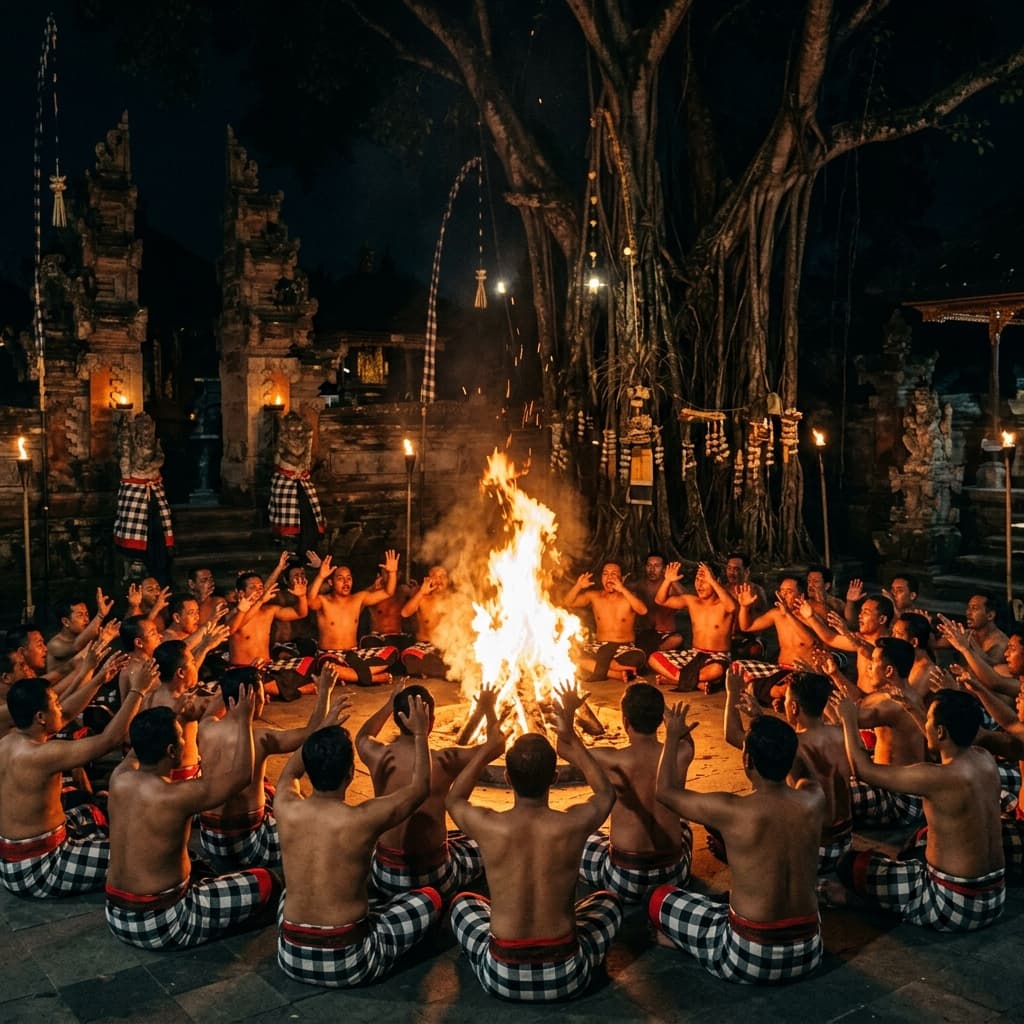
There are two types of people who have watched Kecak in Bali. The first watch it in Uluwatu—mesmerized by the cliffs, fire, and dramatic sunset. The second watch it in Ubud—and return with something harder to explain. Not just awe of the view, but because something felt real. Like touching a tradition that is truly alive, not just staged. If you haven't watched Kecak in Ubud, this article is why.
Ubud and Kecak: A Relationship Beyond Just a Venue
Uluwatu gives drama. Ubud gives soul. It doesn't mean Kecak in Uluwatu isn't authentic—the performance is extraordinary. But there's a different dimension offered by Ubud as the capital of Balinese art and culture. This is where the artists live. This is where traditions are maintained not for the audience, but for the community.
When you sit at Pura Dalem Taman Kaja or Pura Dalem Ubud and hear the first "cak" echoing among the giant trees surrounding the temple, you're not in a theater. You're inside the same space that Balinese ancestors have used for centuries to pray, summon spirits, and maintain the balance of the universe. That's what makes Ubud different.
7 Unique Features of Ubud Kecak You Won't Find Anywhere Else
1. A Living Venue Inside the Temple, Not in Front of It
In Uluwatu, the Kecak performance is held in an open amphitheater specifically built for shows. It faces the sea—grand, dramatic, and stunning. In Ubud, the Kecak performance happens inside the actual temple complex. In the same temple courtyard where religious ceremonies are held. Under giant banyan trees that have silently witnessed hundreds of years of prayers and rituals. The difference isn't about the view; it's about the aura. In Ubud, you're not watching Kecak from the outside—you're invited into the heart of it.
2. An Intimate Atmosphere that Dissolves the Boundary Between Audience and Dancers
The capacity of the Kecak performance in Uluwatu can reach 1,400 spectators. That's equivalent to a medium-sized music concert. In Ubud, venues like Pura Dalem Taman Kaja are much smaller. Spectators sit just a few meters from the dancers. You can see their facial expressions. You can feel the wind moving as the dancers raise their hands. When the fire is lit, you feel the heat on your face.
3. The Dancers Are Local Villagers Not Paid Professionals
In Ubud, most Kecak dancers come from the same village community. They are farmers, traders, teachers—ordinary citizens who inherited this tradition from their fathers and grandfathers. They don't perform just for contracts or salaries. They perform because it's part of their identity. Because the "cak" chanting they chant is the same sound heard by their ancestors hundreds of years ago.
4. Performances Almost Every Night at Different Venues
One of Ubud's rarely mentioned advantages: you can watch Kecak here almost every night, at four different venues spread around Ubud each with a unique character and atmosphere. From the Agung Rai Museum of Art, Pura Dalem Gede, Peliatan Palace, to Pura Dalem Taman Kaja—each venue brings its own flavor. From artistic museum settings and royal palace elegance to the sacred serenity of a village temple. This means you can choose the experience that best fits your mood. And if you're in Ubud for more than one night, you can even watch it more than once and feel the distinct difference between them.
5. Full Moon Performance An Experience Only in Ubud
At the ARMA Museum Ubud, there's a special Kecak performance held on full moon nights. Imagine sitting under the open sky, in the middle of an art museum complex, with the full moonlight illuminating the dancers and the fire burning between them. Nothing can replicate that experience. Not Uluwatu, not GWK, not any other venue in Bali. This is one of the rarest and most magical performances you can find in all of Bali.
6. Jungle and Nature Nuance Adding a Spiritual Dimension
While Uluwatu provides the sea and cliffs as a backdrop, Ubud provides something else—jungle, rice fields, and the night air smelling of earth and flowers. The "cak" chanting echoing among the old trees surrounding the temple creates a natural and hypnotic acoustic effect. It feels like the sound is coming from deep within the earth itself, not from human mouths. And when the show ends, you aren't greeted by the sound of traffic or city crowds. You're greeted by Ubud's deep silence, which somehow makes everything you just witnessed feel even more meaningful.
7. Easier to Access Without Traffic and Risk of Running Out of Tickets
One of the biggest complaints travelers have about Kecak in Uluwatu is the journey—it can take 60–90 minutes from Ubud, Seminyak, or Canggu, with almost certain traffic jams before the show. In Ubud, Kecak venues can be reached by foot from most accommodations in the city center. No traffic at the end of the trip. No long queues since venue capacities aren't in the thousands. This isn't just about convenience; it's about how you arrive at the performance. Walking through Ubud's quiet alleys, passing small shops and canang sari vendors, then arriving at the temple gate just as the oil lamps begin to glow—that's all part of the experience.
So, Ubud or Uluwatu Kecak?
Honestly, the answer is: both are worth watching. Both provide incredible experiences.
But if you only have time to choose one, and you want a deeper experience—more personal, more spiritual, more authentic—then Ubud is the answer. Uluwatu provides a visually stunning performance. Ubud provides a soul-stirring experience.