
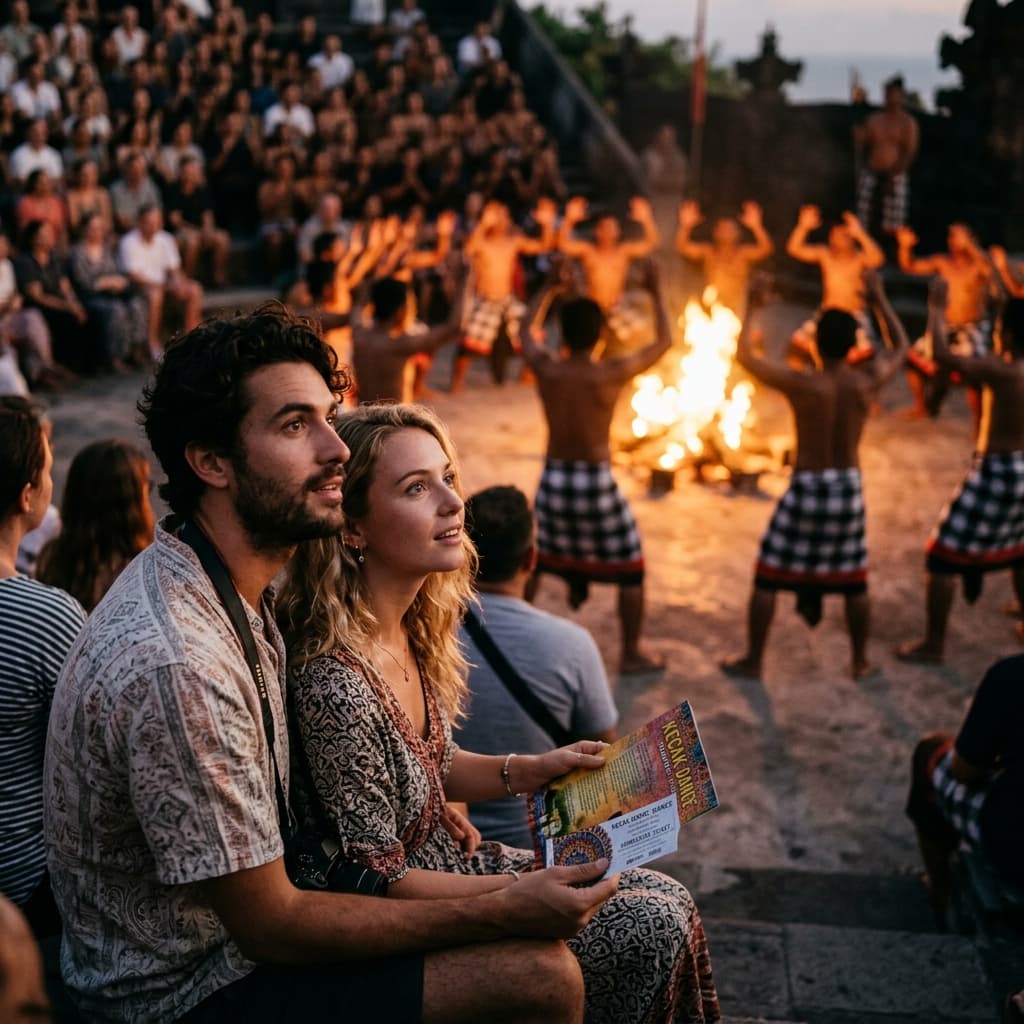
1930. Ubud was still a small village amidst Bali's jungles and rice fields. A German man with ever-curious eyes sat under a tree, watching a ritual he didn't fully understand, but which kept him from leaving. The sound, that's what held him. Dozens of men sat in a circle in the darkness, chanting "cak cak cak" incessantly, while a dancer in the center seemed to fall into another world. His body moved as if it weren't his own. His eyes saw something others couldn't. That man was Walter Spies. And that night, without realizing it, he was witnessing the seeds of something that would change the world of performance art.
This is the story of how the Kecak Dance was born, and why Ubud is where it all began.
Before Kecak: The Sacred and Mysterious Sanghyang Ritual
To understand Kecak, you must first understand what preceded it. Long before there were tourist performances, tickets, or stages, the Balinese people had a ritual called *Sanghyang*. Sanghyang was a sacred ceremony held when a village faced catastrophe, disease, crop failure, or spiritual turmoil. In this ritual, the 'cak' chanting collectively performed by a group of men was believed to have the power to open the door between the human and spirit worlds. A chosen dancer would enter a state of trance, a holy possession, and become a mediator between the community and greater spiritual forces. They would speak, move, and act on behalf of the gods or ancestors inhabiting their body. Not a show. Not entertainment. It was a serious life-and-death ritual. In this context, the 'cak' sound was not music. It was a mantra, a collective vibration believed to move spiritual energy and protect the community from evil. This is the foundation of the Kecak Dance you know today.
Walter Spies and Goa Gajah Temple, The Moment That Changed Everything
Walter Spies arrived in Bali in 1927. A talented artist and musician from Dresden, Germany, he immediately fell in love with Bali in ways he never predicted. He settled in Ubud, built a house, learned the language, and befriended local artists and community leaders. Every night, he wandered to temples and ceremonies, witnessing Balinese spiritual life with wide-open eyes. One night, he witnessed the Sanghyang ritual at Goa Gajah Temple, an ancient temple in Bedulu, Gianyar, not far from Ubud. Something in that chanting touched something within him. As a musician, he heard an extraordinary structure in those layered 'cak' sounds, complex rhythms, polyphonic, and possessing an emotional power he found in no Western music. A question began to grow in his mind: *What if that sound were used to tell a story?*
A Meeting of Two Worlds, Walter Spies and Wayan Limbak
This is where the second figure in this story enters: Wayan Limbak. Wayan Limbak was an extraordinary Balinese dance artist from Bedulu Village. He was not just a skilled dancer, he was a guardian of tradition who understood the spiritual meaning behind every movement and sound. He knew the Ramayana story inside out. And he knew exactly how the power of Sanghyang chanting worked in Balinese culture. When Walter Spies shared his idea, Wayan Limbak didn't immediately agree. There were long conversations. Questions of boundaries, what could be touched, what must remain sacred. Ultimately, they found a middle ground: they would take the *sound* of the Sanghyang ritual, the hypnotic 'cak' chanting, and combine it with the *story* of the widely known Ramayana epic. The result was not a sacred ritual, nor mere entertainment. It was something new, a form of performance art that had never existed before. In 1930, the first Kecak performance was staged publicly.
Why Was This Revolutionary? Understanding the Boldness of the Creation
To understand how radical Spies and Limbak's decision was, you must understand the context. The entire Balinese performance tradition used gamelan, a rich and complex orchestra of percussion instruments, as accompaniment. Gamelan was the heart of every Balinese dance. Without gamelan, there was no Balinese dance. Or so everyone believed. Spies and Limbak did something unthinkable: they discarded all instruments and replaced them with the *human body itself*. No gamelan. No flutes. No gongs. Only human mouths, vibrating chests, and moving hands. This wasn't just a technical change, it was a profound philosophical statement. That the human body itself is the perfect instrument. That when dozens of voices unite in one rhythm, they can create something far exceeding what any instrument can do. And they were right.
From Ubud to the World, How Kecak Conquered International Stages
Early Kecak performances caught the attention of Bali's expat community and the few foreign tourists visiting Ubud in the 1930s, a small but influential group of artists, anthropologists, and cultural explorers. Wayan Limbak then did something even bolder: he took the Kecak Dance out of Bali, touring various countries with his troupe, introducing the world to a performance without equal. Wherever they performed, the reaction was the same: amazement. No one had ever seen hundreds of humans creating music solely with their voices while staging a drama full of emotion and visual beauty. Kecak didn't just become famous, it became one of the most recognized representations of Indonesian culture worldwide.
Kecak in Ubud Today, A Living Heritage
More than 90 years after that first night, the Kecak Dance is still performed in Ubud, in the same temples, by the same communities, with the same spirit. Not as a cultural museum. Not as a replica. But as a tradition that is still *living* and *breathing*. The dancers you see tonight at Pura Dalem Taman Kaja or Pura Dalem Ubud are direct heirs to what Wayan Limbak and Walter Spies began. They bear the responsibility of ensuring that the chanting first echoed on a night in 1930 never stops being heard. And every ticket you buy doesn't just buy access to a show. It is your contribution to ensuring this tradition lives on, that the next generation will inherit something precious and real.
Quick Facts about Kecak History You Should Know
- 1927, Walter Spies arrives in Bali and settles in Ubud
- Early 1930s, Spies witnesses the Sanghyang ritual at Goa Gajah Temple, Bedulu
- 1930, The Spies & Wayan Limbak collaboration gives birth to the first Kecak Dance
- 1930s, Wayan Limbak begins taking Kecak outside Bali to international stages
- 1942, Walter Spies passes away, but his legacy lives on through Limbak and the community
- Today, Kecak is performed at over 10 venues across Bali every night, watched by millions of tourists worldwide annually