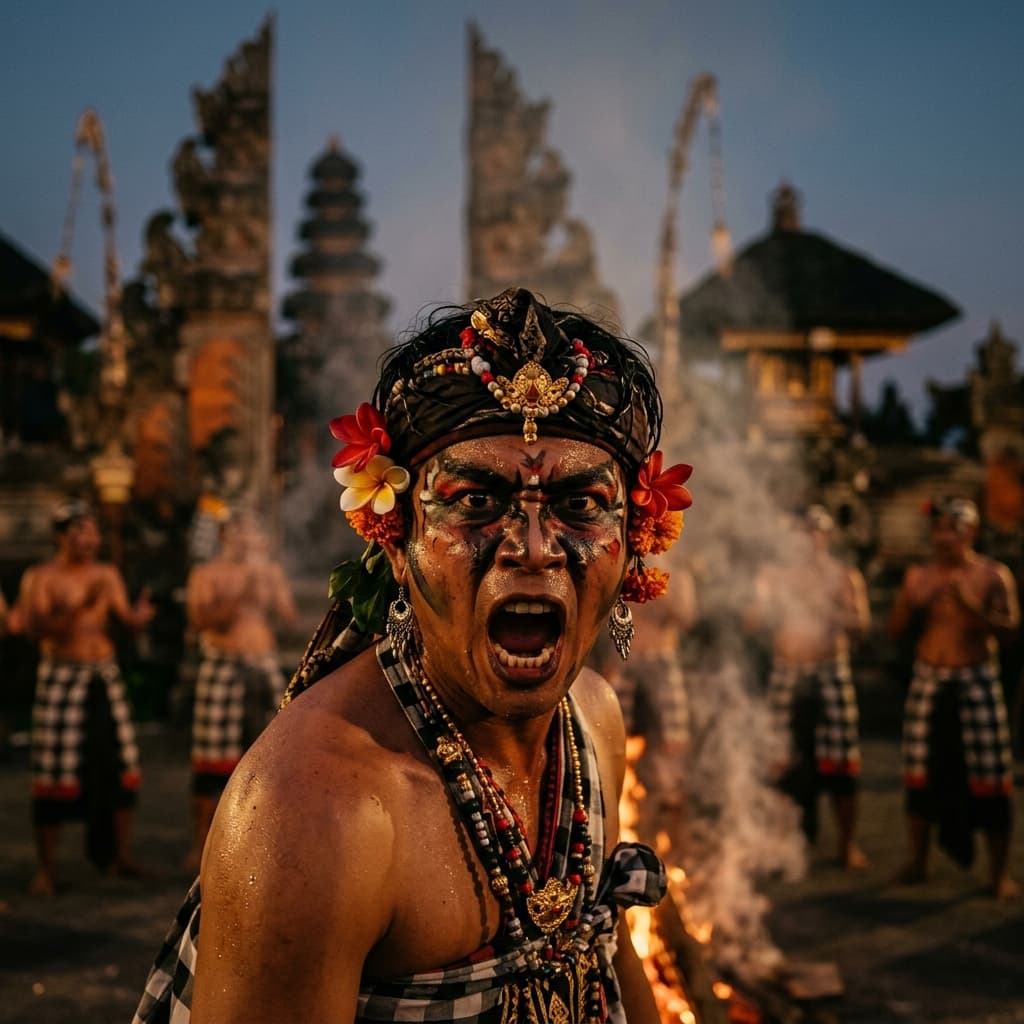
You sit there, observing dozens of men circling under the torchlight. And suddenly, that sound arrives: *'Cak... cak... cak...'*
Slowly at first. Then louder. Faster. Layer upon layer. One voice becomes two, two becomes ten, ten becomes a hundred—until the air around you vibrates as if the earth itself were pulsing. You don't understand the language. You don't know what's happening spiritually. But something inside you reacts—chills, moved, or even unconsciously holding your breath.
It's no coincidence. The 'cak' sound you hear tonight isn't just vocal choreography chosen because it sounds good. It is a fragment of something much older, deeper, and more alive than any travel brochure can explain. This is the story behind it.
Before the Performance: Understanding the Balinese Spiritual World
To truly understand the meaning behind the 'cak' chant, you need to step for a moment into how Balinese people view the universe. For Balinese Hindus, the world doesn't just consist of what can be seen and touched. There are deeper layers of reality—the spirit world, ancestral energy, divine power, and dimensions that flow parallel to everyday human life.
In this cosmology, the balance between the visible world (*sekala*) and the unseen world (*niskala*) isn't just a philosophical concept—it's a matter of life and death. When that balance is disturbed—when evil forces begin to threaten a community—people don't just pray. They *act*. They hold rituals. And one of the most powerful rituals they have to restore that balance is Sanghyang.
Sanghyang — The Mother of Everything
Long before the Kecak Dance was born in the form we know today, the Sanghyang ritual had existed for centuries as part of the Balinese spiritual system. Sanghyang is a ritual of *summoning*. Not just a prayer—but an active process to invite the presence of holy spirits, purified ancestors, or divine energy to descend into the human world and provide help.
In this ritual, a dancer who has been spiritually chosen and prepared will enter a state of *possession*—a trance condition where their consciousness steps aside and another energy takes its place. In this state, the dancer may speak in languages they don't understand, move in ways impossible in a conscious state, or deliver messages from the other world to the gathered community. The *vehicle* for this process—the one that opens the door, that creates the spiritual conditions allowing that connection to happen—is sound. Not gamelan. Not any instrument. The human voice itself.
Why 'Cak'? The Secret Behind Bali's Most Famous Syllable
A rarely asked but vital question: of all possible sounds that could be used, why 'cak'? The answer isn't as simple as it seems.
In the Sanghyang tradition, the 'cak' sound chanted collectively and repeatedly isn't chosen at random. It is a sound believed to have a specific *resonant frequency*—a vibration that, when produced by many people simultaneously in the right conditions, is capable of creating real changes in the energy of a space.
Imagine a sound wave. One person says 'cak'—that's one small ripple. But when 50, 80, even 150 people say it together in a precisely coordinated rhythm—it's no longer a ripple. It's a wave. And waves, in Balinese spiritual belief, are power. The Balinese believe that the collectively echoing 'cak' sound has the ability to:
- Expel negative energy — The vibration frequency generated is believed to be uncomfortable for negative entities, forcing them away from the space protected by the chanting.
- Open the space between — In Balinese spiritual terminology, the layered 'cak' chanting creates a condition where the boundary between the *sekala* and *niskala* worlds becomes more permeable—easier for invited spiritual energy to cross.
- Unite collective energy — When dozens of people produce the same sound at the same time, something happens collectively that exceeds the sum of its parts. Modern psychology calls it *group consciousness*. Balinese tradition calls it—*collective power summoning the greater*.
Anatomy of the Chanting — More Complex Than It Sounds
An untrained ear might hear the Kecak chanting as a single sound repeated monotonically.
But that is far from the truth. In the true structure of Kecak chanting, there are at least *three different sound layers* running simultaneously, filling each other in a very complex polyrhythmic pattern:
1. First Layer — Pengemong (Chant Leader) One person sitting in a key position within the circle, tasked with providing the *root note* and starting the chanting. He is a conductor who uses no baton—only his own voice and full control over the collective energy of dozens of people around him. A strong and experienced Pengemong is the most valuable asset in a Kecak group. 2. Second Layer — Penecek (Pressure Giver) A group of dancers tasked with providing *rhythmic accentuation*—high and low vocal pressures that create melodic contours within the chanting. They are the ones who make the 'cak' feel alive and undulating, rather than flat. 3. Third Layer — Pangumbang (Base Support) The largest group providing the *sound foundation*—a deep and constant base sound that becomes the ground for the entire chanting structure. Without the pangumbang, the chanting loses its weight.
These three layers run simultaneously, stacking in a pattern that—if visualized—would look like an incredibly complex and beautiful web of threads. And all this complexity is created without a score. Without aids. Purely from body memory trained over many years.
The Circle — A Symbol That's More Than Just a Formation
One thing immediately visible when watching Kecak is the dancers' formation: a circle. But this circle isn't just an aesthetic choice or stage practicality. It is a spiritual symbol rich with meaning in Balinese cosmology. In Balinese Hindu belief, the circle represents *perfection* and *infinity*. It has no beginning and no end—like time, like the cycle of life, like the turning of karma.
More than that, the circular formation in the Sanghyang ritual has a specific spiritual function: it creates a *protected space*. An energetic boundary separating what is inside the circle from what is outside. Inside that circle—in the empty center where the main dancers move, where the fire is lit, where the Ramayana story takes place—is sacred space. A space where the ordinary and the extraordinary meet. Outside the circle is the everyday world. Inside the circle is 'the other place.' And you, as the spectator, sit between those two worlds.
Fire — More Than Just a Dramatic Effect
Of all the elements in the Kecak Dance, perhaps none is more thrilling—and more often misunderstood—than the fire ritual at the end of the performance. When Hanuman, the white monkey messenger of Rama, dances upon burning embers barefoot and unharmed—spectators usually react with a combination of awe, horror, and disbelief.
But in the spiritual context of Kecak, what's happening is much deeper than just a stunt. Fire in Balinese Hindu tradition is *Agni*—a manifestation of the most primal and direct divine power. Fire isn't just a physical phenomenon. It is a living presence—an element with the power to purify, transform, and connect the human world with higher dimensions. When the Hanuman dancer enters the embers, what's happening—in the Balinese spiritual interpretation—isn't just a human demonstrating physical endurance. It is a *sacred test*:
Is the spiritual energy summoned through the 'cak' chanting strong enough to provide protection to the body entering the fire space? When the dancer emerges from the fire without injury—and in authentic Kecak, they indeed are not injured—it is a confirmation. Confirmation that the chanting was successful. That the energy was summoned. That protection was granted. Not a trick. Not an illusion. For the community performing it—it is proof.
The Pre-Performance Ritual You Never See
There is one part of the Kecak Dance that is never shown to the audience—but without it, the performance cannot begin. Before the dancers enter the performance arena, they undergo a series of preparatory rituals that can last from 30 minutes to over an hour.
The dancers are sprinkled with *tirta*—holy water prayed over by a pemangku (priest)—to cleanse their energy from any negative influences gathered from their daily activities. This isn't a symbolic ceremony—it's an *energetic cleansing* considered absolutely necessary before entering sacred space.
The dancer leading the fire scene undergoes even more intensive preparation. He is not only sprinkled with tirta—he also goes through a process of meditation and prayer that prepares his consciousness to receive the necessary protective energy.
The white frangipani (*kamboja*) tucked behind the dancers' ears isn't a fashion accessory. In Balinese culture, the frangipani flower is a symbol of connection between the human and divine worlds—it invites sacred presence and repels the unwanted.
The black-and-white checkered cloth (*poleng*) wrapped around the dancers' waists represents *Rwa Bhineda*—the fundamental duality of the universe: good and evil, light and dark, life and death. The dancers wear this duality on their bodies as a reminder that they are standing at the meeting point between two great forces.
What Actually Happens to the Audience?
There is a phenomenon consistently reported by travelers from various cultural and religious backgrounds watching Kecak for the first time: they get chills. Many cry without knowing why. Some feel they've accidentally entered a semi-meditative state. This isn't suggestion or romantisization. There's an interesting explanation.
Psychologically, the 'cak' sound repeated in complex patterns creates an effect similar to *binaural beating* techniques in modern meditation—layered sounds moving at different frequencies can gradually shift the listener's brainwaves from beta (everyday active consciousness) to alpha (calmness, receptivity).
In other words: the 'cak' chanting designed thousands of years ago to induce trance in dancers also has a measurable effect on the audience. You aren't possessed by a spirit. But you aren't entirely in your usual state of consciousness either. You are in-between. In the gray space between the rational and the spiritual. Exactly where the entire Kecak performance is designed to take you.
And perhaps that is the true gift of the Kecak Dance—not just a beautiful sight, not just a stunning performance—but a brief experience of becoming more permeable. More open. A little bit closer to something greater than oneself.
Ubud Kecak — Where This Meaning Is Most Felt
You can watch Kecak in many places in Bali. But the spiritual depth of this meaning isn't felt with the same intensity everywhere. In Ubud—at Pura Dalem Taman Kaja, under the great trees circling the temple courtyard, with the sounds of frogs and cicadas from the surrounding gardens filling the gaps between chants—there is something different.
Perhaps it's because the temple itself is a spiritually living space, not just a performance venue. Perhaps it's because the dancers are members of the same community that uses the temple for prayer every day. Perhaps because the smaller scale makes the chanting feel as if it's coming not from 'over there'—but from *within*.
Whatever the reason, one thing is certain: those who have watched Kecak in many places often say that Ubud is where they first truly *felt* what lies behind the performance. Not just saw it. Felt it.